
Watching over a sleeping infant can feel like a full time job, and choosing the right baby monitor makes that job easier. You want reliable audio and video, alerts that actually wake you, and a setup that does not bury you in notifications. Pick the wrong system and you trade sleep for false alarms or poor range. That is why a smart baby monitor matters: it keeps your baby safe, helps you sleep better, and frees you to move around the house without anxiety. In this guide I break down the top monitors across categories, from budget audio units to feature rich Wi Fi cameras, and explain the core features worth paying for like battery life, latency, night vision, and data privacy. You will get clear pros and cons, real world testing notes, and simple buying tips so you can pick one that fits your family’s routine. Start here confidently.
Best Baby Monitors
Nanit Smart Baby Monitor System with Floor Stand

I’ve been using the Nanit for a while now, and it’s one of those products that’s genuinely impressive but not perfect.
The biggest thing you notice right away is the overhead camera angle. It gives you a full view of the crib all the time, which sounds small but actually makes a big difference compared to side-angle monitors where your baby can roll out of frame. The video quality is solid too, clear enough day and night without needing to constantly adjust anything.
Where Nanit really stands out is the sleep tracking and insights. It doesn’t just show you your baby—it tries to explain what’s going on. Some days that’s incredibly helpful (especially for figuring out sleep patterns), and other days it feels like a bit too much data when you’re already tired.
The included 8" display is a nice addition. I didn’t think I’d care, but not having to grab my phone every time is actually pretty convenient.
That said, there are a couple of downsides. The biggest one is the subscription. You get basic monitoring without it, but most of the interesting features are locked behind a monthly plan, which adds up. Also, since the camera is fixed overhead, you don’t get the flexibility of pan/tilt.
Overall, I’d say this is great if you’re into tracking and want deeper insights. If you just want a simple monitor, it might feel like overkill.
Check price from AmazonOwlet Dream Sock – Smart Wearable Baby Monitor

I’ll be honest, this is one of those products you don’t need, but you might really want, especially in those early newborn weeks.
The Owlet Dream Sock isn’t a traditional monitor at all. There’s no camera, no screen, it’s basically a wearable sensor that tracks your baby’s heart rate and oxygen levels in real time . And if you’ve ever found yourself checking your baby’s breathing for the fifth time in an hour, you’ll immediately understand why this exists.
When it works smoothly, it’s incredibly reassuring. Instead of guessing whether everything is okay, you can just glance at the app and know. That alone can help you relax a bit more, especially overnight.
That said, it’s not perfect. The biggest issue is false alarms. They do happen, and when they do, it’s not subtle, you’re suddenly wide awake thinking something is wrong. Over time you learn what’s real vs noise, but those first few nights can be stressful.
The sock itself is comfortable, but getting the fit right takes some trial and error. If it shifts, you’ll get inaccurate readings.
Battery life is decent (about a day), but it does mean charging becomes part of your daily routine.
Also worth mentioning—the app is good, but some of the deeper insights require a subscription, which feels a bit annoying given the upfront price.
Overall, this is great for peace of mind, but it’s not essential for everyone.
Check price from AmazonLollipop WiFi Baby Monitor

The Lollipop Baby Monitor (CABC-LOL) is a Wi‑Fi, app‑controlled 1080p video camera aimed at parents who want easy, tool‑free crib mounting and clear day/night imaging. Its main angle is a flexible wrap‑around mounting arm that secures to crib rails without tools, paired with AI True Crying Detection to cut down false sound alerts. It fits families who will keep the camera plugged into an outlet and who value multi‑user cloud access, Alexa integration and simple app sharing.
In practical use the camera delivers Full HD 1080p video with vibrant daytime color and auto‑activating IR night vision for crisp black‑and‑white night contrast. The fixed 122° field of view covers a crib area but there is no remote pan, tilt or zoom, so repositioning requires adjusting the bendable arm. Two‑way talk is push‑to‑talk through the Lollipop app, which supports multiple cameras, at least six simultaneous viewers, built‑in lullabies and Echo Show integration. AI cry detection and virtual‑border motion alerts are included; the Lollipop Care Plan (7‑day trial) is required for breathing monitoring, sleep tracking and extended video history. An outdoor cloud view is available but limited to 30‑minute sessions.
Trade‑offs are straightforward. The camera is AC‑corded only, so it is not portable or resilient to power outages. Some sources report below‑average live audio with background noise and occasional Wi‑Fi disconnections. Important features like breathing monitoring and longer video history are behind a paid subscription. For parents who need remote pan/tilt, battery operation, pristine continuous audio or local‑only storage, this is not the best choice. For parents who prioritize easy crib mounting, strong 1080p imaging and AI cry alerts at a modest price, the Lollipop is a sensible option.
Check price from AmazonMomcozy BM04 Smart WiFi Baby Monitor

The Momcozy BM04 is a midrange smart baby monitor that combines a dedicated 5-inch parent unit with both an FHSS non-WiFi link and 2.4GHz WiFi app access. That dual-mode approach is the unit’s main angle: it lets parents keep a private local connection at home while still allowing remote viewing and family sharing. The source notes suggest it will appeal to parents who want plug-and-play simplicity, a portable parent screen, and the option to let multiple caregivers follow along.
In practical use the BM04 packs clear, 1080p Full HD video and color night vision that reviewers found noticeably better than cheaper options. The 5-inch parent display is portable and powered by a 5000mAh battery rated for about 10+ hours of continuous use. Audio quality includes two-way talk and VOX voice-activated monitoring; two-way audio is described as clearer than lower-end alternatives. The camera offers a 360-degree effective viewing area via repositioning plus 4x digital zoom rather than a true motorized pan/tilt. Alerts include motion, cry, temperature, and a configurable danger zone, and recording works with an SD card for continuous or motion-triggered capture. Setup is reported to be very quick.
Limitations are straightforward. The camera does not provide true motorized pan/tilt, recording requires an SD card, and some motion/position alerts can be frequent for anxious parents. The product also lacks advanced AI sleep analytics and some privacy or cloud details are not provided in the available evidence. For families who want a private local link plus remote app access, the BM04 is a practical, easy-to-use choice; those needing motorized PTZ, built-in cloud recording, or medical‑grade monitoring should look elsewhere.
Check price from AmazonOwlet Dream Duo (Gen 3) Smart Baby Monitor
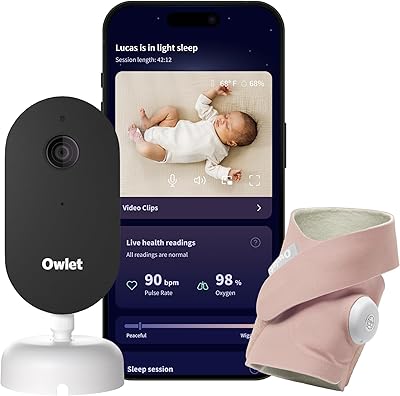
The Owlet Dream Duo (Gen 3) Smart Baby Monitor combines a 2K HD camera with the company’s FDA-cleared Dream Sock to deliver both video and physiological tracking in one package. Priced at $299.99 and designed for babies 1–18 months (6–30 lbs), it will appeal most to parents who want real-time oxygen and heart-rate data alongside sharper-than-1080p video. It is an app-based system (Android 7+ and iOS 14+) for caregivers comfortable relying on a smartphone or tablet as the parent unit.
In practical terms the camera is a clear strength: 2K resolution, a 130-degree wide-angle lens and usable 4x zoom make crib coverage broad and detail easier to read than many 1080p rivals. Night vision is reported as good enough to visually check breathing, and the app supports audio and talk-back so caregivers can soothe from a distance. The Dream Sock supplies FDA-cleared pulse oximetry with oxygen and heart-rate alerts, while the system also tracks room temperature, humidity and includes predictive sleep features. Security is notable for a consumer monitor, with 256-bit encryption and an SGS cybersecurity mark, and the camera works anywhere there is internet via Wi‑Fi.
That said, there are important trade-offs. False alarms are frequently reported and can be disruptive overnight. The sock can be fussy to fit, may slip off when a baby kicks, performs poorly with lotion on the feet, and its battery is described as mediocre and likely needs frequent charging. The app-only workflow means losing the view if a phone is unavailable or dead, and some buyers will object to cloud/Wi‑Fi dependence. Overall, the Dream Duo stands out for parents who prioritize integrated, FDA-cleared health monitoring and higher-resolution video; others seeking a simpler, local-only or low-maintenance monitor should consider alternatives.
Check price from AmazoniBaby Smart WiFi Baby Monitor M7 Lite
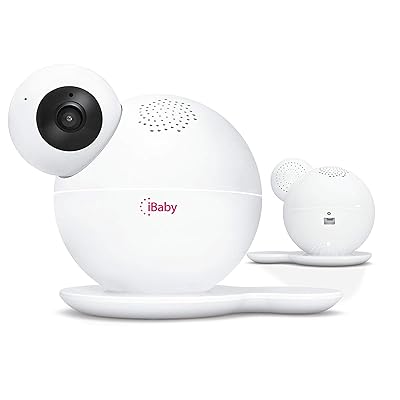
The iBaby Smart WiFi Baby Monitor M7 Lite (iBaby Care M7 Lite) is a feature-packed, app-controlled 1080p video monitor priced at $299.99. The source notes suggest its main selling point is very strong low-light imaging paired with built-in environmental sensing, so it will appeal to parents who prioritize clear night vision and want room air monitoring in the same device. It is best suited to families comfortable with an app-only workflow and remote access rather than a dedicated parent unit.
On the video side the M7 Lite offers Full HD streaming, a 360° pan and 110° tilt range, 4x digital zoom, and infrared night vision with Night Color mode driven by eight IR LEDs and an effective range up to about 15 feet. Two-way talk, sound and motion VOX alerts, and dual-band WiFi are supported for remote viewing. The app ecosystem is rich: split-screen multi-camera views, family sharing, thousands of licensed lullabies and story tracks, growth logging, Alexa compatibility, and no subscription requirement. Environmental sensors report temperature, humidity, air quality (TVOC/VOC) and CO2, and the device includes configurable feed/diaper alarms. Setup satisfaction was high in aggregate according to the source notes.
However, the M7 Lite is relatively large and needs a substantial surface or wall mount. The source notes highlight an unintuitive app experience, inconsistent odor/diaper alert performance, and mixed reports on audio quality and long-term reliability, with some units reported to fail within a year. The moonlight soother’s movement can be jerky and may disrupt the camera view. Families with unreliable WiFi, strict local-only privacy needs, a requirement for compact hardware, or those seeking medical-grade monitoring should look elsewhere. For parents who want best-in-class night video plus air-quality sensing and accept app-driven trade-offs, the M7 Lite is a compelling, feature-rich option.
Check price from AmazonInfant Optics DXR-8 PRO
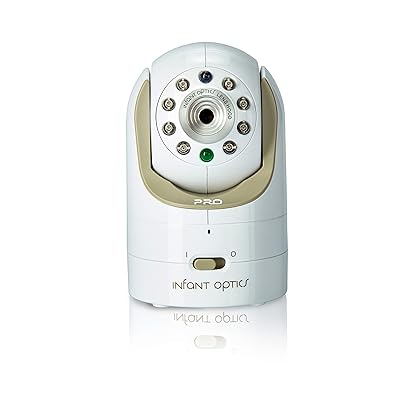
The Infant Optics DXR-8 PRO is a straightforward, privacy-focused baby monitor that sticks to the basics and does them well. It’s a non-WiFi system with a 720p camera and a 5-inch parent unit, designed for parents who don’t want apps, cloud storage, or anything internet-connected. Setup is quick (usually just a few minutes), and the whole experience feels simple and reliable rather than overly “smart.” It’s especially appealing if you prefer a closed system that just works without troubleshooting connectivity issues.
In day-to-day use, the video feed is clear and stable for a non-WiFi monitor, and the low-light color night vision is a nice touch compared to standard black-and-white infrared. You also get practical features like remote pan/tilt/zoom, two-way talk, VOX mode (screen wakes on sound), and temperature alerts. Audio is helped by Active Noise Reduction, which cuts down background sounds like fans or AC. The system supports up to four cameras, making it useful for growing families, and overall build quality feels solid, with splash resistance adding a bit of durability.
There are some trade-offs. Battery life on the parent unit is the biggest one—it averages around six hours, so you’ll likely need to keep it plugged in overnight. Audio can occasionally sound a bit quiet or slightly static at higher volumes. Since there’s no WiFi, you also won’t get remote viewing or advanced smart alerts. Overall, it’s a great choice if you want a dependable, no-frills monitor with strong privacy but less ideal if you’re looking for app-based features or long portable battery life.
Check price from AmazonVTech Smart HQ Max Twin WiFi Baby Monitor
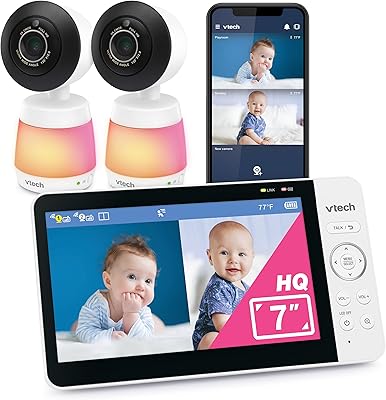
The VTech Smart HQ Max Twin is a two‑camera video baby monitor sold at $224.95 that targets parents who want a large, dedicated parent unit and the ability to watch two rooms at once. The source notes emphasize its unique angle: a 7" IPS split‑screen parent display plus hybrid connectivity that combines local FHSS operation for privacy with optional 2.4 GHz Wi‑Fi for remote access. It suits parents of twins or multiple children, and families who prefer no subscription fees for motion, sound and temperature alerts.
In practical terms the system delivers useful hardware. Cameras use a 2K CMOS sensor with 1080p FHD output, 135° ultra‑wide field of view, full 360° pan and 105° tilt, and strong zoom (24x local, 30x remote via the app). Night vision is automatic IR, and two‑way talk, VOX voice activation, lullabies and a multi‑color night light are built in. The rechargeable parent unit runs about 12 hours with video or roughly 18 hours in audio‑only mode, and setup is described as plug‑in and power‑on without account creation. Alerts include motion, sound and temperature with short clip replay and no required subscription.
There are real tradeoffs to consider. Split‑screen viewing only provides audio from one camera at a time, which can be tedious; the parent unit’s off‑center kickstand can tip easily; and playback of lullabies or sounds from the parent unit may overpower live room audio. The product is also large and not ideal for travel. Some technical gaps remain in the available evidence, such as exact wireless range, encryption details and whether cameras are battery portable. Overall, the Smart HQ Max Twin is a practical, privacy‑friendly choice for in‑home multichild monitoring but less suited to parents who need compact travel gear or seamless multi‑camera audio.
Check price from AmazonBabysense PRO Full HD 5.5" Split Screen Baby Monitor
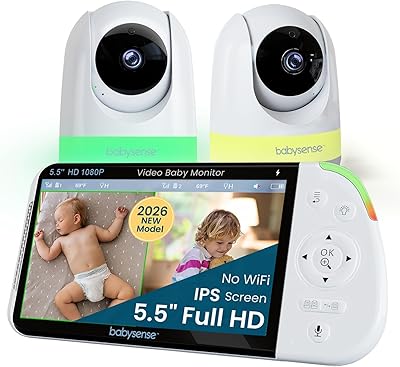
The Babysense PRO Full HD 5.5" Split Screen Baby Monitor (MVPRO-2CAM, $169.98) is a two-camera, closed-system video monitor aimed at parents who want straightforward, privacy-friendly room monitoring without WiFi or cloud apps. Its defining angle is the true split-screen parent unit that displays two 1080p feeds at once, which makes it particularly useful for parents of twins or caregivers who need to keep an eye on two rooms simultaneously. The system is sold as a plug-and-play alternative for families avoiding internet-connected cameras.
In practical terms the Babysense PRO delivers clear Full HD video from each included PTZ camera and supports digital zoom, pan and tilt from the parent unit. Night vision plus a 6-color adjustable RGB night light and a built-in white-noise machine in each camera reduce the need for extra nursery gadgets. The monitor uses a 2.4 GHz FHSS closed wireless system and includes VOX/Eco Mode so the parent screen wakes on sound or motion; the manufacturer claims up to 20 hours battery in Eco Mode and the parent unit is rechargeable while the cameras are AC powered. The provided feedback summary emphasizes high ease-of-use and strong perceived value and quality.
However, there are real trade-offs to consider. Audio is limited to one camera at a time, some users report inconsistent parent-unit battery life despite the claim, and occasional signal drops have been reported even on the closed 2.4 GHz link. Room temperature readings can be uneven, and some units reportedly stopped working unexpectedly. For parents who want a simple, private, two-camera Full HD monitoring setup the Babysense PRO is a solid choice; those needing app-based remote viewing, guaranteed all-night battery life, simultaneous audio from multiple cameras, or medical-grade monitoring should look elsewhere.
Check price from AmazonHelloBaby HB6560 Baby Monitor
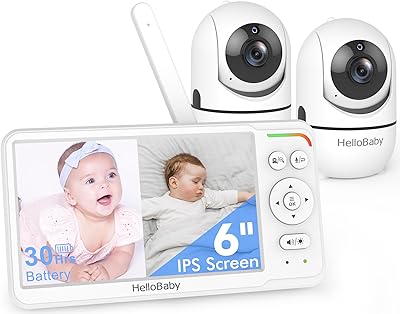
The HelloBaby HB6560-2 is a standalone, privacy-first dual-camera baby monitor sold as a 2-camera pack for about $139.98. It is designed for parents who prefer a plug-and-play system without Wi‑Fi or app connectivity. The unit ships pre-paired and uses 2.4 GHz FHSS encrypted transmission so caregivers who dislike smartphone apps or cloud services can use a dedicated 6" IPS parent monitor with true split-screen and simple controls.
In practical use the monitor emphasizes audio reliability, range, and flexible viewing. Cameras offer pan 355 degrees, tilt 120 degrees and 2x digital zoom, and daytime video is encoded as HD MPEG‑4, though source notes describe the image as budget-grade and low in fine detail. Night vision is automatic with invisible IR, two-way talk works reliably, and VOX/ECO modes wake the screen on sound and show a visual sound-level LED when muted. The system claims up to 1,000 feet outdoors on the product page and reviewers report longer open-field ranges and roughly 190 feet through multiple walls indoors. Extras that parents will use include temperature alerts, eight lullabies, a feeding timer, and support for up to four cameras. Cameras are plug-in only; the parent unit is battery powered with a listed 16–30 hour runtime depending on ECO/VOX mode, though some user reports raise questions about long-term battery consistency.
The trade-offs are clear. Video is grainy compared with modern high‑definition smart monitors, the 2x digital zoom quickly pixelates, and there is no app, cloud recording, motion tracking, or battery-powered camera option. Some ergonomic annoyances and mixed reports about the parent unit battery appear in the source notes, and slightly higher EMF readings led to a recommendation to position cameras at least six feet away. For parents who want a simple, secure, long‑range, app‑free monitor focused on audio and basic video, the HB6560-2 is a practical, affordable choice; parents who need crisp HD night video, app features, or portable battery cameras should look elsewhere.
Check price from AmazonVTech Advanced HQ Max Twin

The VTech Advanced HQ Max Twin is a two-camera, screen-first baby monitor priced at $149.95 that targets parents who want a large dedicated parent display and a local, non-WiFi connection. Its main angle is a 7-inch IPS True Color LCD with split-screen so both cameras can be watched at once, paired with a closed 2.4GHz FHSS link that keeps video and audio on a local connection. It fits caregivers who need out-of-the-box dual-room monitoring for twins or two spaces without relying on apps or cloud services.
On practical features it covers the essentials. HQ cameras deliver 600p video with a 110° wide-angle lens and a low-light color night-vision mode that preserves more scene detail than typical black-and-white IR. Cameras support remote pan 360°, tilt 122° and 4x digital zoom. The system includes two-way talk, motion and sound alerts, a room temperature sensor, a controllable multi-color night light, and five calming sounds. Cameras are AC powered; the parent unit runs on a 5000mAh rechargeable battery rated up to 12 hours. Setup and ease of use are noted strengths, and the closed FHSS approach avoids Wi‑Fi setup and cloud access for those with privacy concerns.
There are clear trade-offs to weigh. The 600p picture is not as sharp as 1080p alternatives, audio volume and battery reliability have mixed reports, and the kit is limited to the two included cameras with no expandability. Some users reported occasional signal drops and early unit failures, and charging uses a proprietary cable rather than USB-C. For parents who need expandable, app-based remote viewing or the highest-definition video, this is not the best pick. For families wanting a simple, private, large-screen dual-camera monitor, it remains a practical option.
Check price from AmazonCuboAi Smart Baby Monitor 3:

The CuboAi Smart Baby Monitor 3 (Gen 3) is a WiFi video monitor that positions itself as an AI-first option for parents who want high-resolution footage and deep sleep analytics. Priced at $254, it pairs a 2.5K QHD camera with AI features such as cry, cough, covered-face and rollover alerts, plus growth tracking and 30-day sleep reports. This makes it a compelling choice for tech-savvy parents, families planning multi-camera setups, or anyone who values long continuous review when monitoring a newborn or infant.
In practical terms the camera delivers a 2560 x 1440 image with a 135 degree wide-angle view and auto-activating IR color night vision for low-light monitoring. Two-way audio is included, along with accurate temperature and humidity sensing and app controls for alert thresholds, lullabies, and danger zones. The system stores up to 72 hours of continuous video playback with key-moment tagging, supports family sharing for up to eight members, and integrates with Google, Alexa and smartwatches. Setup is reported to take about two minutes and the app runs on Android 12+ and iOS 14+. Security is noted as PSTI certified WiFi security with WPA/WPA2.
There are clear trade-offs. The camera is AC-powered only, so it is not portable, and the lens is fixed with no remote pan, tilt or zoom. The source notes suggest some users experience app connectivity issues and occasional AI false alarms, and the floor-stand option can feel wobbly. Those who need battery operation, PTZ control, a dedicated parent monitor, or offline/local-only storage may want to look elsewhere. For parents who prioritize high-resolution video, extended playback and robust AI alerts, the Gen 3 is a strong, feature-rich pick; however some operational and connectivity caveats mean buyers should confirm WiFi reliability and subscription or support details before committing.
Check price from AmazonMiku Pro Smart Baby Monitor
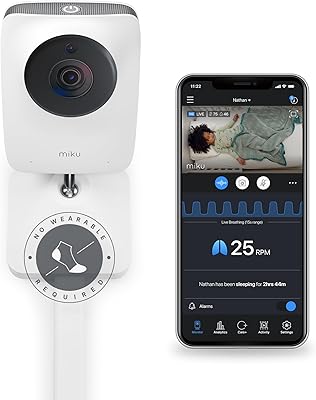
The Miku Pro Smart Baby Monitor is a 1080p Wi‑Fi video camera with a distinctive angle: contact‑free, real‑time breathing monitoring using SensorFusion. The source notes suggest this makes it a fit for new parents who want wearable‑free respiratory tracking alongside high‑quality video and app-driven sleep analytics. It is designed for families comfortable using a smartphone or tablet as the parent unit and for households that can install an AC‑powered, wall‑mounted camera.
In practical use the Miku Pro pairs crisp Full HD day video with automatic IR night vision that works in total darkness, plus two‑way talk and built‑in lullaby/white‑noise playback. The app displays live respirations and breathing‑rate data and issues real‑time breathing, motion, and sound alerts; the breathing tracking is reported to work through blankets and across different sleep positions. Connectivity is dual‑band Wi‑Fi with Bluetooth 4.1 and the camera can continue streaming locally if the internet drops but the local network remains. Security features include a tamper‑resistant crypto chip, dual‑layer encryption, and two‑step authentication. A full wall‑mount hardware kit is included and the app supports multi‑user sharing and simultaneous encrypted streams to more than one device.
There are clear trade‑offs. The camera is fixed‑lens only with no pan, tilt, or zoom and it requires AC power, which limits placement. It is pricier than many competitors and some users report app reconnection delays; advanced storage and deeper analytics require a $9.99/month membership. The source notes suggest it is not a medical device and should not replace clinical monitors. For parents seeking reliable wearable‑free breathing awareness plus strong 1080p video, it is a compelling option; those needing cordless operation, motorized camera control, simultaneous multi‑camera viewing, or medical‑grade monitoring should look elsewhere.
Check price from AmazonMotorola Nursery PIP1710 Connect Baby Monitor

The Motorola Nursery PIP1710 Connect is a hybrid video baby monitor that pairs a 5" touchscreen parent unit with smartphone app access, combining a dedicated FHSS local link and WiFi remote viewing. It is aimed at parents who want a modern in-home monitor plus offsite access, and who value Motorola's BeyondCry AI insights about why an infant is crying rather than just a basic sound alert.
On paper it covers the essentials parents expect: 1080p Full HD video with infrared night vision, motorized pan and tilt with 4x digital zoom, and two-way talk via a high-sensitivity microphone. The touchscreen makes quick nighttime checks easy; VOX mode wakes the screen on sound and the camera reports motion, temperature alerts, and AI cry-type notifications to both the parent unit and the app. The camera is AC powered while the parent unit runs on a 2950mAh rechargeable battery rated up to 10 hours. Local reliability comes from the up-to-1,000-foot FHSS link, while WiFi unlocks unlimited remote viewing through the Motorola Bebé app. Extras include built-in lullabies and temperature monitoring.
Trade-offs are real. The PIP1710 sits at a premium price point ($230) and the parent-unit battery life is described as typical despite the up-to-10-hour rating. The camera requires AC power, so fully wireless placement is not possible, and offsite monitoring depends on internet access. Some technical details are not provided in the source notes (camera field-of-view angle, warranty terms, detailed encryption specs, or supported multi-camera limits). For parents who want a reliable local feed plus smartphone access and AI cry insights this is a solid, feature-rich option; budget buyers or those needing battery-powered cameras or clinical-grade monitoring should look elsewhere.
Check price from Amazoneufy Security Baby Monitor E20

The eufy Security Baby Monitor E20 (Model T8352) is a hybrid video monitor that pairs a 2K pan/tilt camera with a dedicated 5 inch 720p parent unit and optional smartphone app access. Its main selling point is the hybrid connectivity model: the camera can connect to the parent unit directly when WiFi is off, while app access enables remote viewing when desired. That physical WiFi on/off switch and local-mode capability make it a fit for parents who want privacy control, caregivers who prefer a standalone screen, and families who travel or need a portable, plug-and-play setup. The listed price is $119.99.
In practical terms the E20 emphasizes visible, flexible monitoring over advanced analytics. Daytime video is sharp thanks to the 2K sensor, and the wide-angle coverage combined with 330 degree pan and 60 degree tilt plus 4x digital zoom helps scan a nursery. Two-way talk uses Active Noise Reduction claimed to cut background noise by about 20dB, and VOX mode with five sensitivity levels limits unnecessary alerts. Alerts include cry detection, loud-noise and temperature monitoring, split-screen support for two cameras, and 24/7 recording with an SD card. Power comes from an internal 5,000mAh battery offering roughly nine hours in normal use and about 5.5 hours with night vision; the unit can also remain plugged in for overnight monitoring. Security features include a physical WiFi toggle and RSA-1024 plus AES-128 encryption.
However, the E20 has trade-offs parents should weigh. Users may encounter intermittent WiFi connectivity and occasional app latency, and night-vision footage is softer than daytime video. Zoom is digital and degrades detail, and there are isolated reports of reliability variation. Accessories like docks are sold separately, and battery life is solid but not class-leading. For parents seeking ultra-low latency, medical-grade monitoring, or flawless always-on WiFi performance, this is not the best choice. For those seeking a mid-price, privacy-conscious, travel-friendly monitor with a real parent unit and strong daytime video, the E20 is a practical option rather than a premium, AI-driven sleep coach.
Check price from AmazonGoodBaby SM663 5" Baby Monitor

The GoodBaby SM663 is a budget, privacy-first baby video monitor that uses FHSS wireless rather than WiFi or an app. Priced at $36.99, it aims at parents or caregivers who want a simple plug-and-play screen-based monitor with strong offline security. It fits new parents, grandparents, and anyone who prefers no-cloud operation and will place the camera fairly close to the crib to make the most of its modest resolution.
In practical terms the unit pairs a 5-inch LCD parent monitor with a 480p camera that pans 355 degrees, tilts 120 degrees, and offers 2x digital zoom. Night vision is automatic and rated to work in total darkness without visible light, and two-way talk, VOX sound-activated wake, room temperature alerts, eight lullabies, and a feeding timer are all included. The camera is marketed as having up to 960 feet range and a 3500mAh battery with claimed runtimes of about 30 hours in VOX/audio mode or 10 hours with the screen on. Reviewers report usable facial detail at short distances (around six feet). The lack of WiFi or an app keeps setup straightforward and reduces exposure to internet-based hacking.
Trade-offs are clear. The 480p image loses detail at distance and when using digital zoom, VOX sensitivity is reported as inconsistent, and there is no motion detection or cloud features. Battery longevity shows mixed real-world reports, and some technical details such as frame rate, exact night-vision range, charger type, and warranty are not specified in the available evidence. The SM663 is a sensible, low-cost choice for privacy-minded caregivers who want an uncomplicated local monitor; those who need remote app access, motion-based alerts, higher resolution, or medical-grade monitoring should look elsewhere.
Check price from AmazonLeapFrog LF915HD Baby Monitor

The LeapFrog LF915HD is a dedicated video baby monitor built around a privacy-focused, closed 2.4 GHz wireless link and a large 5-inch 720p parent display. The source notes suggest its main angle is offering on-unit monitoring with color night vision, an adaptive dimmable night light, and built-in soothing sounds, making it a fit for parents who want a non-Wi‑Fi system with a roomy screen and handy comfort features in the nursery.
In practical terms the monitor delivers a 720p image from a 110° wide-angle lens with up to 8x digital zoom and pan/tilt capabilities listed as 360° pan and tilt support. Night vision switches automatically between color and black-and-white modes. The parent unit is rechargeable (5000 mAh) and rated for up to 15 hours of continuous video or 22 hours of audio-only use, with VOX sound-activated wake to save power. Two-way talk, motion and sound alerts, plus temperature and humidity notifications are included. The camera is AC powered, the unit is wall-mountable, and an adaptive night light and five lullabies add practical convenience for overnight soothing.
However, the source notes also flag meaningful trade-offs. The interface is described as complicated and some physical details are inconvenient, such as unlit monitor buttons and a short camera power cable. Reliability reports are mixed, with occasional freezes, disconnections, and some lag or feedback on two-way talk; battery longevity also drew mixed feedback. It is not expandable and the product page states no Wi‑Fi or app support, which prevents multi-camera setups or smartphone viewing. For parents prioritizing local, on-site monitoring and color night vision on a budget, this is a solid choice; those needing app access, multi-camera expandability, or guaranteed lag-free two-way audio should look elsewhere.
Check price from AmazonMotorola Nursery PIP15 Audio Baby Monitor

The Motorola Nursery PIP15 (PIP15-2MULTI), priced at $69.99, is a privacy‑first, audio-only DECT baby monitor built for parents who want simple, reliable listening across two rooms. The source notes suggest its main angle is simultaneous multi‑room audio rather than video or cloud features, so it fits households that prefer a non‑WiFi solution and pre‑paired, plug‑and‑play units. It will appeal to caregivers who prioritize clear sound, VOX‑activated sleep monitoring, and compact hardware without an app or subscription.
In practical use the PIP15 offers a 1.88–1.90 GHz DECT connection with a stated range up to 1,500 ft line of sight, two-way talk, and VOX mode to mute ambient noise until louder sounds occur. The parent unit has a bright 1.5 inch backlit LCD that displays room temperature, sound levels and battery status. Each baby unit includes a built‑in night light that can be controlled locally or from the parent unit, and the set ships pre‑paired with included USB‑C adapters and spare AAA battery support. It supports simultaneous audio from two rooms and can work with up to four baby units, and because there is no Wi‑Fi or cloud dependence users avoid app accounts and subscription fees.
However, there are clear tradeoffs. The PIP15 provides no video, so families wanting visual monitoring or remote app viewing should look elsewhere. Battery performance is reported as mixed despite a stated up to‑9‑hour runtime, and some users have noted temperature readings can be inaccurate. There is no auto‑on scheduling and limited warranty details are not provided in the available notes. Overall, the PIP15 is a solid, private audio monitor for parents who need dependable two‑room listening, but anyone needing video, app integration, or guaranteed overnight battery life should consider alternate solutions.
Check price from AmazonVTech DM1411 Audio Baby Monitor

The VTech DM1411 is an audio-only baby monitor built around privacy and simplicity. Using DECT 6.0 wireless transmission, it avoids Wi‑Fi and app accounts, so the emphasis is on hearing your baby rather than watching. The package includes a parent unit and a baby unit with an integrated portable soother shaped like Myla the Monkey, making the DM1411 a practical pick for parents who want a travel-ready monitor plus a sound machine and soft night light without cloud connections.
In practical terms the product evidence highlights clear audio pickup that can detect small noises, crying and movement, plus two-way talk and a five-level LED sound indicator for visual monitoring when the parent unit is muted. VTech rates range up to 1,000 feet in open field, and consumers report the monitor works across multiple rooms and floors in typical homes. The baby unit offers five lullabies and five soothing sounds, a dimmable night light and an auto shut-off for the soother after 60 minutes. Both units have built-in rechargeable batteries and AC adapters are included; VTech rates portable use up to eight hours. The units arrive paired with no app required, and the DECT link reduces interference common on crowded Wi‑Fi networks. Out-of-range alerts are provided.
There are notable trade-offs. Battery life is inconsistent in practice and may not deliver reliable all-night run time; some users report sudden volume jumps and uneven behavior when white noise plays. Soothing sounds must be started at the baby unit rather than from the parent unit, the system is not expandable and it lacks video, motion or temperature alerts. Mixed reliability reports and charger/charging quirks are also recorded. For parents who need a simple, private audio monitor and a built-in travel soother, the DM1411 is a sensible low-tech choice. Those who want video, guaranteed all-night battery life, remote control of sounds or multi-camera expandability should look elsewhere. Some technical details such as exact battery capacity, charge time and VOX behavior are not specified in the available product evidence.
Check price from AmazonTimeFlys Audio Baby Monitor

The TimeFlys Audio Baby Monitor (listed as the Mustang Panda and sometimes referenced as the QQ Portable in review notes) is a budget, audio-only monitor priced around $42. It is aimed at parents who want a simple, plug-and-play solution with useful extras rather than a Wi‑Fi video system. The unit emphasizes practical features for in-home use: a temperature display with alarm, a baby-unit night light that can be controlled remotely, lullaby playback, and a press‑and‑hold two‑way talk button. Users who want an inexpensive, feature-packed audio monitor will find it an attractive value.
In practical terms the monitor keeps things straightforward. It uses VOX sound-activation with an optional vibration alert and includes an LCD parent unit showing room temperature. Rechargeable batteries and USB-C charging are supported on both units, and the baby unit has a backup battery option. Review notes report stronger-than-average noise cancellation, which helps keep false wakeups to a minimum. Manufacturer range is listed as up to 150 ft indoors and 1,000 ft outdoors; review notes measured about 115 ft through seven walls and 575 ft open-field, the shortest open-field distance among the tested group. Setup and controls are intuitive, and an extra parent unit can be purchased affordably.
There are trade-offs. Range is modest for its class and review notes say the VTech DM1211 delivered roughly 50 ft more through-walls reach. Users may also encounter audio feedback when both units sit in the same large room at distances over about 20 ft. Documentation is limited, with no printed or online manual provided, and some technical details like exact battery runtimes or pairing limits are not available in the notes. For budget-conscious parents who prioritize quiet operation, temperature monitoring, and portability, TimeFlys is a sensible, high-value pick. Those who need long-range coverage, video, Wi‑Fi features, or detailed product documentation should look elsewhere.
Check price from AmazonMotorola AM21 Nursery Wireless Audio Baby Monitor

The Motorola AM21 Nursery Wireless Audio Baby Monitor is a no-frills, audio-only monitor that aims to keep things simple and private. Priced at $17.59, it uses a DECT private connection (1.88–1.90 GHz) with five interference-free channels and advertises up to 1,000 ft line-of-sight range (around 300 metres indoors). That makes it a fit for parents who want a basic, screen-free way to hear a newborn or infant without WiFi, apps, or subscriptions. It also suits budget buyers looking for a cheap secondary unit for travel or grandparents.
In practical terms the AM21 focuses on core functions. The baby unit plugs into AC power while the compact parent unit runs on two AAA batteries or can be corded. A high-sensitivity microphone with VOX cry detection, LED sound alerts and simple volume control are provided so caregivers can hear crying and bedside noises; the unit lists a 30 dB noise level and is described as sturdy and quick to set up. Because it relies on DECT rather than home WiFi, users should expect a private, low-complexity connection with clear-enough audio for monitoring without a glowing screen in the bedroom.
The trade-offs are plain. There is no video feed, no two-way talk, and no smart features such as app access, cloud storage or motion/physiological sensing. Battery life in portable mode is reported as mixed or short and batteries are not included; some sound quality is described as slightly tinny. The listing does not provide exact battery-hour figures, warranty length or detailed audio specs. For parents who need visual checks, two-way communication, long battery-only run times or medical-grade monitoring, this is not the right choice. For those who want an inexpensive, private, easy-to-use audio monitor, the AM21 is a pragmatic, low-cost option.
Check price from Amazon
Comments
Post a Comment